Building Beyond the Founder with Chuck Frank
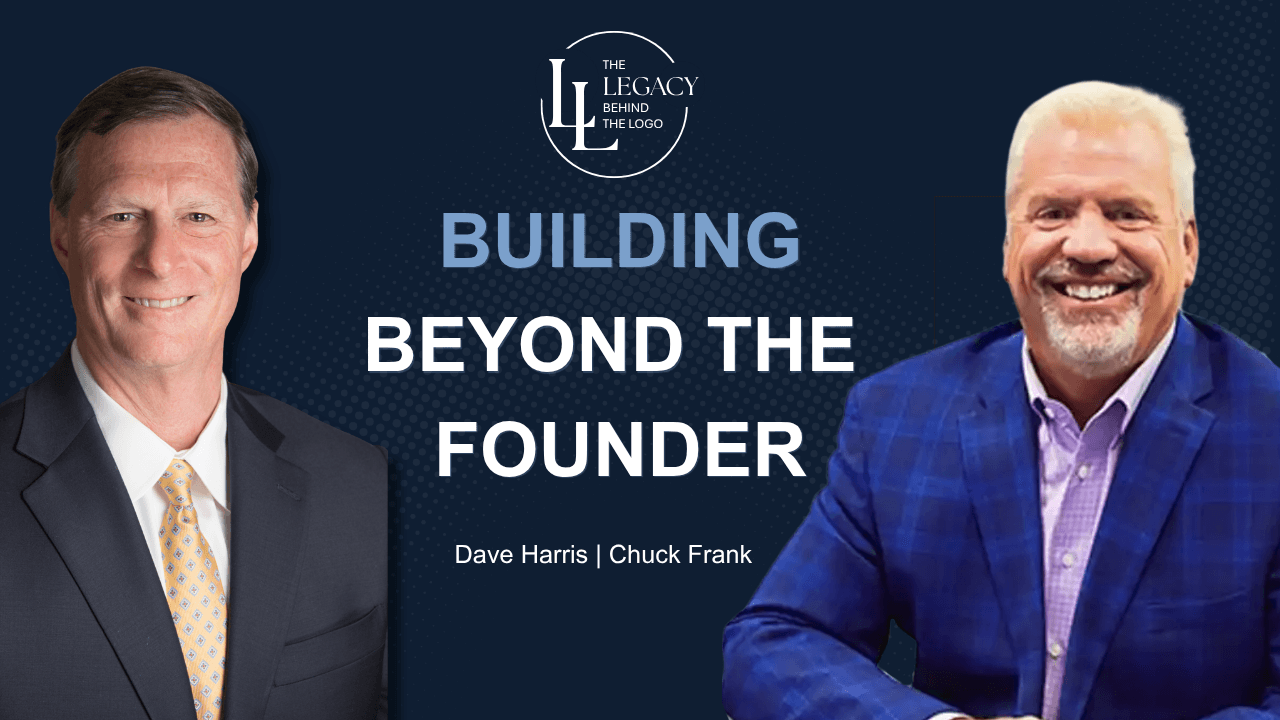
Chuck Frank bought out his father, sold the business in 2014, and stayed on with the buyer for eight years. Then he started over. Today he co-owns a new company with his son and two longtime colleagues. On this episode of The Legacy Behind the Logo, he walks through what each chapter taught him.
Dave Harris and Chuck have been friends for more than two decades. That history shows up in the conversation, which covers the parts of ownership that rarely make it into a business plan.
Growing Up Inside the Business
Chuck's father joined a Cincinnati material handling company in the early 1970s as roughly its sixth or seventh employee. He later acquired one of its divisions, Advanced Handling Systems. Chuck started working there while still in school. He became a minority owner, bought out his father, and eventually ran the company himself.
He describes a generation that worked 65 to 70 hours a week, six days a week, and saw nothing unusual about it. Working alongside his father showed him both the rewards and the hard days. He also watched how family relationships and business decisions pull against each other.
Compensation was one of the hardest parts. When you work with family, Chuck says, you tend to be harder on them. It is easier to deny a raise to your son than to anyone else. His answer was to tie pay to the industry, the numbers, and a clear job description.
Dave adds a distinction every family business eventually faces. A family member can be a wonderful son or daughter and still not be the right executive. Those are two separate questions.
An Open Book, Even During a Sale
When Chuck bought out his father, the senior leaders who would become his partners saw everything: the profitability, the successes, and the failures. Any question was fair game. By the time decisions had to be made, nobody was surprised.
He brought the same approach to selling the business. The buyer, a third-generation family company in the same industry, approached him. The two sides spent 18 months getting to know each other before closing. Throughout, Chuck made sure his team understood the deal and why he was doing it.
His reasoning was practical. A serious buyer looks hard at the leadership team, and the real question is whether that team can run the business. If it cannot, he asks, what is the buyer really buying?
He also framed the sale as an opportunity. A 50-person company offers limited room to advance. A 500-person company with multiple departments can offer far more to people who are good at what they do.
Dave agrees, and adds that sharing your plans means taking responsibility for your team's success. The alternative is announcing a done deal after the money is wired. To him, that feels hollow.
Write the Job Description Before You Sign
After the sale, Chuck reported to someone for the first time in his career. He is honest that the transition can be hard for any owner.
His advice sounds unusual at first. Before you sell, write the job description for the role you want afterward. Include the schedule, the responsibilities, the commitment, and what success looks like. Then bring it to the buyer.
Not every buyer will accept it, and that is fine. Chuck's point is that you set the ground rules at the start. His agreement called for five years. He stayed eight.
Dave shares the other side. His first business sale, when he was around 40, did not work out the way he had hoped. His bigger mistake was not selling for enough to walk away if he was unhappy. He did not have outside counsel then, and he believes it would have changed the outcome.
Who the Buyer Answers To
Dave spends time on a point many owners miss about private equity. When a private equity firm buys a company, the company is not its client. The fund's investors are. That is why, in his experience, these firms typically plan to sell again within several years.
He is clear that private equity firms are made up of smart people and have a real role. But a majority private equity owner, a minority investor, and a strategic buyer will each create a very different experience.
Chuck adds a caution from his own industry, which he describes as cyclical, with a downturn every three to five years. Explaining a coming rough patch to an investor who needs a return is hard. He has also watched friends sell, see the check clear, and start second-guessing the decision within weeks.
Practice, Business, or Institution
Dave offers a simple test: could you leave for six months and have the business be fine? If not, it may not be worth what you think.
He describes three stages. A practice depends on the owner showing up. A business runs with the owner guiding it. An institution can survive without its leaders, and in his view that is where the real value is.
Chuck shares how his company is working toward that. For years he wrote the business plan himself. Now he gives his leadership team the target and asks them to build the plan.
The first attempt was eye-opening. The goal was $70 million in revenue. The team's plan reached $120 million, and it would also have lost about $7 million. He did not take the plan back. He worked through it with them, and over time his leaders have learned to think like owners.
Both agree on a daily habit: run the business as if a buyer could walk in tomorrow. In Chuck's experience, buyers go straight to the trailing twelve months and the pipeline.
Removing Emotion Before It Is Needed
Chuck is now having the same conversations with his own partners. If he steps away, where will the money to buy his share come from? He wants a plan that does not strain the business or the people buying him out.
The four owners have a buy-sell agreement and clear bylaws, put in place early. His view is that emotion is a distraction. Decide the hard things ahead of time, so that if the trigger ever needs to be pulled, everyone knows what happens next.
Dave returns to a principle he wrote down nearly 20 years ago: before you exit, decide what you want the business to accomplish for you, then work backward.
What They Land On
Asked what legacy means to him, Chuck describes a lunch 20 years from now with the team he left behind. The leaders have become executives, and the company is stronger than it was when he walked out. That, he says, would be a great day.
Dave closes on the reality every owner eventually faces. Business life is a cycle of storms: you are heading into one, in the middle of one, or coming out of one. Leaders have to be taught to steer through them, and that takes time. No owner outlives the business, so the planning has to start well before it is needed.
This article is for educational purposes only and is not legal, tax, or individualized investment advice.
Important Disclosure Information
MCF Advisors, LLC (“MCF”) is an SEC registered investment adviser. Registration as an investment adviser does not imply a certain level of skill or training. The oral and written communications of an adviser provide you with information about which you determine to hire or retain an adviser. More information about the adviser can also be found by visiting: https://adviserinfo.sec.gov/firm/summary/130372. The above commentary is for informational purposes only. Information prepared from third-party sources is believed to be reliable though its accuracy is not guaranteed. This is not intended as an offer or solicitation with respect to the purchase or sale of any security. MCF may only transact business in those states in which it is registered, or qualifies for an exemption or exclusion from registration requirements. Please remember that past performance is not indicative of future results. Different types of investments involve varying degrees of risk, and there can be no assurance that the future performance of any specific investment, investment strategy, or product (including the investments and/or investment strategies recommended or undertaken by MCF), or any non-investment related content, made reference to directly or indirectly in this blog/newsletter will be profitable, equal any corresponding indicated historical performance level(s), be suitable for your portfolio or individual situation, or prove successful. Due to various factors, including changing market conditions and/or applicable laws, the content may no longer be reflective of current opinions or positions. Moreover, you should not assume that any discussion or information contained in this blog/newsletter serves as the receipt of, or as a substitute for, personalized investment advice from MCF. To the extent that a reader has any questions regarding the applicability of any specific issue discussed above to his/her individual situation, he/she is encouraged to consult with the professional advisor of his/her choosing. MCF is neither a law firm nor a certified public accounting firm and no portion of this content should be construed as legal or accounting advice. A copy of MCF's current written disclosure statement and customer relationship summary (“Form CRS”) discussing our advisory services and fees continues to remain available upon request. The scope of the services to be provided depends upon the needs of the client and the terms of the engagement. If you are a MCF client, please remember to contact MCF, in writing, if there are any changes in your personal/financial situation or investment objectives for the purpose of reviewing/evaluating/revising our previous recommendations and/or services.