2026 Mid-Year Review & Outlook

2026 Mid-Year Review & Outlook
Resilient Growth in a Higher-for-Longer World
June 30, 2026
Letter from the Chief Investment Officer
Resilient Growth in a Higher-for-Longer World
The first half of 2026 was a good reminder that successful investing requires distinguishing between sensational headlines and the long-term forces that drive portfolio returns. At the beginning of the year, investors questioned whether the U.S. economy could avoid recession, whether inflation would continue to moderate, and whether market leadership would broaden beyond the Magnificent 7 (“Mag 7”, comprised of Alphabet, Amazon, Apple, Meta, Microsoft, Nvidia, and Tesla). Six months later, many of those questions have been answered—although not always in the ways consensus expected.
Economic growth remained remarkably resilient. Corporate earnings continued to expand, worries about the labor market subsided, manufacturing returned to expansion, and consumer spending continued driving overall economic activity. Financial markets reflected broader participation across a range of asset classes, extending beyond the largest U.S. companies into areas such as small-cap equities, international developed markets, emerging markets, commodities, and select fixed-income sectors. In our view, maintaining a disciplined and diversified investment approach remains a vital component of navigating evolving market conditions.
The most notable change from our January outlook was the re-acceleration of inflation during the second quarter. While inflation remains well below the 2022 peak, recent data suggest it will be a “higher-for-longer” inflationary environment with a more gradual path for inflation to reach the Federal Reserve's long-term objective. While a significant portion of inflation came from the energy shock, today's inflation is occurring alongside continued economic expansion rather than economic contraction, creating a fundamentally different investment environment than the feared high inflation, slow growth economy.
As we enter the second half of 2026, we are certain that uncertainty will persist. Inflation, monetary policy, geopolitics, and market volatility will continue to influence investor sentiment. Rather than attempting to predict every market movement, we remain focused on building resilient portfolios capable of helping clients achieve their long-term objectives across a wide range of economic environments. While the headlines continue to evolve, our disciplined investment philosophy will continue to guide us through changing market cycles.
Investment Committee Perspective
Through changing market environments, our philosophy remains constant: successful investing is built on disciplined planning, strategic asset allocation, thoughtful diversification, and maintaining a long-term perspective. Although inflation has become more persistent than expected, our strategic asset allocation has remained largely unchanged. Healthy earnings growth, resilient employment, and improving manufacturing activity continue to support a constructive long-term outlook. We believe disciplined portfolio construction remains more valuable than frequent tactical shifts based on short-term market developments.
Five Observations That Defined the First Half of 2026
- The U.S. economy remained more resilient than expected despite restrictive monetary policy and the conflict in Iran.
- Inflation reaccelerated during the second quarter, reinforcing a higher-for-longer interest-rate environment.
- Market leadership broadened meaningfully beyond mega-cap technology companies.
- Higher starting bond yields restored fixed income as a meaningful source of income and diversification.
- Small-cap, international, and emerging market equities rewarded diversified investors.
Five Things Consistent with our Outlook
- Resilient economic growth supported corporate earnings.
- Market leadership broadened across regions and market capitalizations.
- Higher bond yields improved long-term income opportunities.
- Artificial intelligence remained an important driver of earnings and headlines, although long-term economic benefits remain uncertain.
- Diversification added value as other asset classes outperformed the S&P 500 so far this year.
Five Things That Changed from our Outlook
- Inflation proved more persistent than expected.
- Manufacturing recovered faster than anticipated.
- The conflict in Iran disrupted energy supplies and caused a spike in prices.
- Emerging markets generated exceptional returns.
- The Federal Reserve remained patient amid stronger growth and a leadership transition.
Updates to 2026 Outlook/Themes
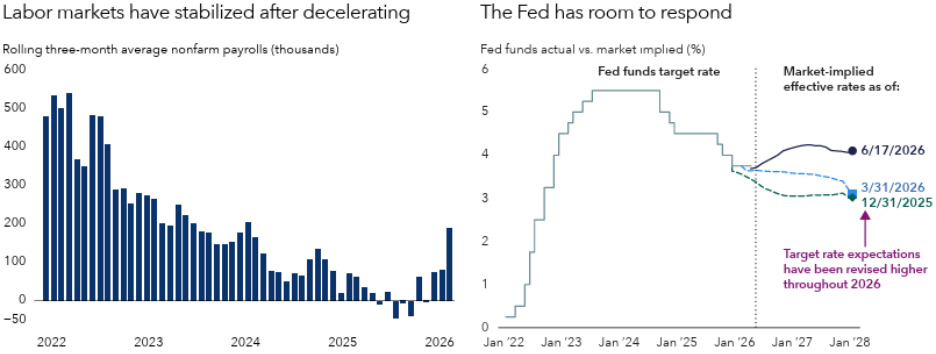
Inflation continues to be a leading concern for investors. We believe inflation may gradually moderate as the effects of the energy supply crunch wear off and prices stabilize. However, consumer demand is resilient, manufacturing is expanding, and the labor market is strong – all providing resistance for inflation to fall too far. Expectations have now shifted to a higher likelihood the Fed increases interest rates sometime later this year, as opposed to many forecasts at the beginning of the year calling for flat or lower rates by the end of 2026.
Looking Ahead
The second half of 2026 is likely to be shaped by the interaction of resilient growth, persistent inflation, healthy corporate earnings, continued volatility, and a broader opportunity set across global capital markets. Rather than attempting to predict short-term market movements, we continue emphasizing diversified portfolios, disciplined asset allocation, and long-term investment decision making.
Part I: Market Review
A Stronger Foundation Than Expected
The first half of 2026 highlighted the potential for resilient economic growth, evolving corporate fundamentals, and broader market participation amid ongoing inflation concerns and restrictive monetary policy. Rather than relying on a narrow group of market leaders, we believe maintaining diversification across multiple asset classes remains an important component of a disciplined long-term investment approach.
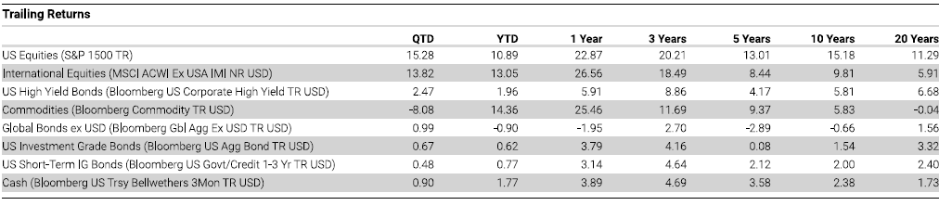
First Half Capital Market Performance (as of 06-30-2026)
Source: Morningstar Direct
Key Takeaways
- Economic resilience supported broad-based gains across global capital markets.
- Market leadership expanded beyond U.S. mega-cap technology companies.
- Small-cap and emerging market equities materially outperformed.
- Fixed income resumed its role as both an income-producing asset and portfolio diversifier.
- Diversification portfolios generally outperformed concentrated portfolios during the first half of 2026.
Broadening Market Leadership
For several years, market performance was heavily concentrated among a relatively small group of large-cap technology companies, aka the “Mag 7”. During the first half of 2026, leadership broadened considerably. Small-cap equities, international developed markets, emerging markets, and commodities all generated strong returns alongside U.S. large-cap equities. This broad participation represents one of the healthiest characteristics of the current market environment and reinforces our long-held conviction that diversified portfolios are better positioned to navigate changing market conditions.
Equity Markets
Corporate earnings remained the primary driver of equity returns during the first half of the year. Large-cap U.S. companies continued benefiting from healthy profitability and ongoing investment in artificial intelligence, while improving economic conditions supported smaller companies and global markets. Broadening participation reduced concentration risk and created a more balanced opportunity set for investors.
Fixed Income
Higher starting yields continued to restore fixed income as a meaningful contributor to total return. Although inflation reaccelerated during the second quarter, investment-grade bonds provided attractive income and diversification benefits, with nearly all sectors positive for the second quarter and year-to-date.
Diversifying Strategies
Commodities started off the year hot thanks to precious metals and heated up even more after energy prices spiked in Q1 as the conflict with Iran escalated. Commodities gave back a portion of earlier gains during the second quarter following the initial energy price shock. High yield bonds benefited from strong corporate fundamentals while private credit continued to have record outflows, negative headlines, and redemption issues for many funds. International bonds were slightly positive in the second quarter but remain negative year-to-date.
Part II: Economic Review
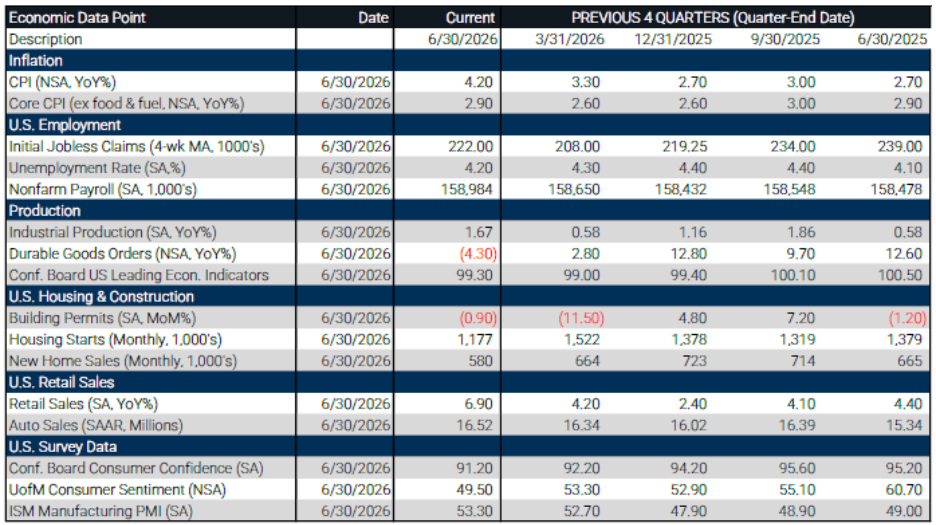
Mid-Year Economic Dashboard
Source: Bloomberg
The Economy Has Changed
The first half of 2026 marked an important transition in the economic cycle. Rather than debating whether the economy could achieve a soft landing, investors increasingly recognized a new environment characterized by resilient growth, persistent inflation, and interest rates that may remain higher for longer. This combination has important implications for portfolio construction and capital market expectations.
Key Takeaways
Economic growth remained stronger than expected, even though inflation reaccelerated during the second quarter. Strong labor markets continued supporting consumer spending. Manufacturing returned to expansion. The Federal Reserve, now under the leadership of Fed Chair Kevin Warsh, maintained a patient, data-dependent stance. Inflation remains above target, especially after recent energy spikes, but underlying (core) inflation also remains persistent.
Inflation: The Story That Changed
While inflation moderated meaningfully during 2025, progress slowed during the second quarter of 2026. Rather than signaling a return to the inflationary environment experienced several years ago, recent data suggest the final stage of inflation returning down toward the Federal Reserve's target may be slower and less predictable. Investors should prepare for a higher-for-longer policy environment while recognizing that inflation is occurring alongside continued economic expansion.
Manufacturing Recovery
The return of the ISM Manufacturing Index to expansion territory represents one of the most encouraging developments of the first half. Improving industrial activity supports our constructive outlook for infrastructure, capital spending, and domestically oriented companies.
Labor Markets and Consumer Spending
Healthy labor markets continue supporting the broader economy. Employment conditions remain favorable, wage growth continues supporting household income, and consumer spending remains resilient despite elevated borrowing costs. These trends reinforce our view that the U.S. economy continues expanding rather than contracting.
Source: Capital Group
Federal Reserve Outlook
The Federal Reserve enters the second half of 2026 facing a more balanced policy challenge. Inflation remains above target while economic growth continues exceeding expectations. We expect policymakers to remain patient, relying on incoming data rather than committing to an aggressive easing cycle.
Portfolio Implications
Resilient economic growth supports corporate earnings, while persistent inflation reinforces the importance of quality companies with pricing power, diversified equity exposure, and income-producing fixed income. We continue emphasizing strategic asset allocation over short-term macroeconomic forecasts.
Investment Committee Perspective
We believe today's economic environment differs materially from 2022, when inflation last peaked. Inflation remains elevated, but it is occurring alongside healthy employment, expanding manufacturing, and resilient corporate earnings. This supports our view that investors may benefit from disciplined long-term allocations rather than making significant tactical portfolio changes in response to short-term market volatility.
Part III: Where We are Today
Broadening Opportunity
The investment landscape entering the second half of 2026 offers a broader opportunity set than investors have experienced in several years. Market leadership has expanded beyond a narrow group of mega-cap technology companies, fixed income once again provides meaningful income, and alternative investments continue to enhance portfolio diversification. We believe disciplined investors should focus on portfolio construction rather than attempting to predict short-term market rotations.
Equity Markets
U.S. Large-Cap Equities
Large-cap U.S. companies continue to benefit from healthy earnings growth, strong balance sheets, and ongoing investment in artificial intelligence and productivity. While valuations remain above long-term averages, we continue to view high-quality large-cap companies as the foundation of diversified equity portfolios.
U.S. Small-Cap Equities
Small-cap equities have been one of the strongest-performing areas of the market during 2026. Attractive valuations, improving manufacturing activity, and resilient domestic growth support our constructive outlook. Although we expect volatility to continue, our investment committee continues to view small-cap equities favorably due to attractive valuations and long-term growth potential.
International Developed & Emerging Markets
International developed markets continue to benefit from attractive relative valuations and improving earnings growth, while emerging markets have been supported by stronger global demand and technology adoption. Together, we believe these allocations provide meaningful diversification and expand the opportunity set beyond the United States.
Fixed Income
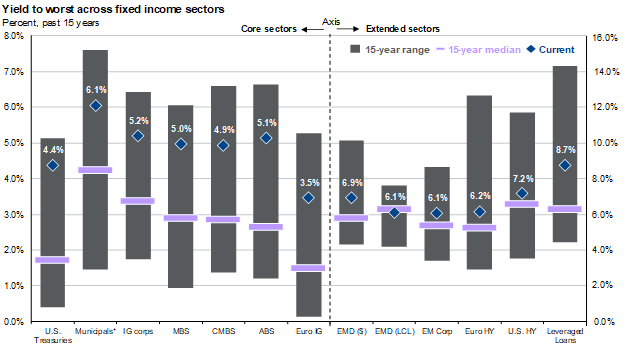
We believe one of the most meaningful developments for investors has been the return of more attractive income opportunities. In our view, higher starting yields have improved the opportunity set for fixed income investors, while reinforcing the potential role of bonds as a source of income and portfolio diversification.
Source: JPM Guide to the Markets
Diversifying Strategies
We believe diversifying strategies, including alternative investments, where appropriate, can continue playing a significant role in helping investors build diversified portfolios. High yield bonds, real assets, and private equity/credit may provide differentiated sources of return while helping mitigate the impact of persistent inflation and changing interest-rate environments.
Portfolio Implications
We continue emphasizing globally diversified equity exposure, high-quality fixed income, and selective alternative investments. Rather than making significant tactical shifts, our focus remains on constructing resilient portfolios designed to navigate a range of economic environments.
Investment Committee Perspective
The first half of 2026 reinforced our conviction that portfolio construction—not market prediction—drives long-term investment success. Broad participation across asset classes supports maintaining strategic allocations while selectively increasing conviction where fundamentals and valuations remain favorable.
Part IV: The Path Ahead
Looking Forward
The first half of 2026 reinforced the importance of maintaining a disciplined investment process. Rather than attempting to forecast every market movement, we believe investors should focus on the fundamental drivers of long-term returns and position portfolios to perform across a range of economic outcomes.
Five Investment Themes for the Second Half of 2026
- Resilient Growth Continues - Economic growth remains stronger than expected and continues to support corporate earnings.
- Inflation Is Likely to Remain Above Target - Inflation may moderate only gradually, reinforcing a higher-for-longer policy environment.
- Artificial Intelligence Broadens Beyond Technology - AI investment is increasingly translating into productivity gains across multiple sectors.
- Income Matters Again - Higher yields continue to improve the role of fixed income within diversified portfolios.
- Diversification Remains Important - Broader market participation highlights the potential benefits of maintaining a strategic asset allocation approach.
Key Market Risks We are Watching
- Persistent or potentially rising inflation.
- Unexpected Federal Reserve policy changes.
- Geopolitical uncertainty, especially for international markets.
- Fiscal deficits and government debt.
- Elevated equity valuations combined with a slowdown in earnings growth.
Scenario Analysis
Scenario | Likelihood | Investment Implications |
Base Case | Most Likely | Maintain diversified strategic allocations. |
Bull Case | Less Likely | Cyclical assets and growth equities outperform. |
Bear Case | Least Likely | Quality, income, and defensive assets become increasingly valuable. |
Second-Half Outlook
Although uncertainty remains elevated, we believe the current investment environment presents opportunities for investors who maintain a disciplined, long-term approach. In our view, factors such as economic resilience, corporate earnings trends, and broader market participation may support a diversified investment strategy. We continue to monitor potential risks, including inflation, geopolitical conflicts, and monetary policy developments.
Closing Thoughts from the Chief Investment Officer
Successful investing has never been about eliminating uncertainty. Every market cycle presents a distinct set of opportunities and challenges, yet the principles that drive long-term success remain remarkably consistent. The first half of 2026 highlighted the continued importance of a disciplined, diversified investment approach as market conditions evolved amid changing headlines, inflation concerns, and monetary policy developments.
As we enter the second half of the year, our outlook remains constructive but measured. We expect markets to continue responding to economic data, corporate earnings, and Federal Reserve policy. Rather than attempting to predict each market movement, we remain committed to strategic asset allocation, thoughtful diversification, and long-term investment discipline.
Thank you for the trust you place in MCF Advisors. We appreciate the opportunity to serve as your investment partner and remain committed to helping you pursue your long-term financial goals.
MCF Investment Philosophy
Markets evolve. Economic cycles change. Technology advances. Investment principles endure. At MCF Advisors, we believe successful investing begins with thoughtful planning, disciplined portfolio construction, and a long-term perspective. We seek to build resilient portfolios designed to perform across a wide range of economic environments rather than attempting to predict short-term market movements.
We believe diversification should be intentional, risk should be managed rather than feared, and patience remains one of the greatest competitive advantages available to long-term investors. These principles guide our investment process and our commitment to serving clients through changing market cycles.